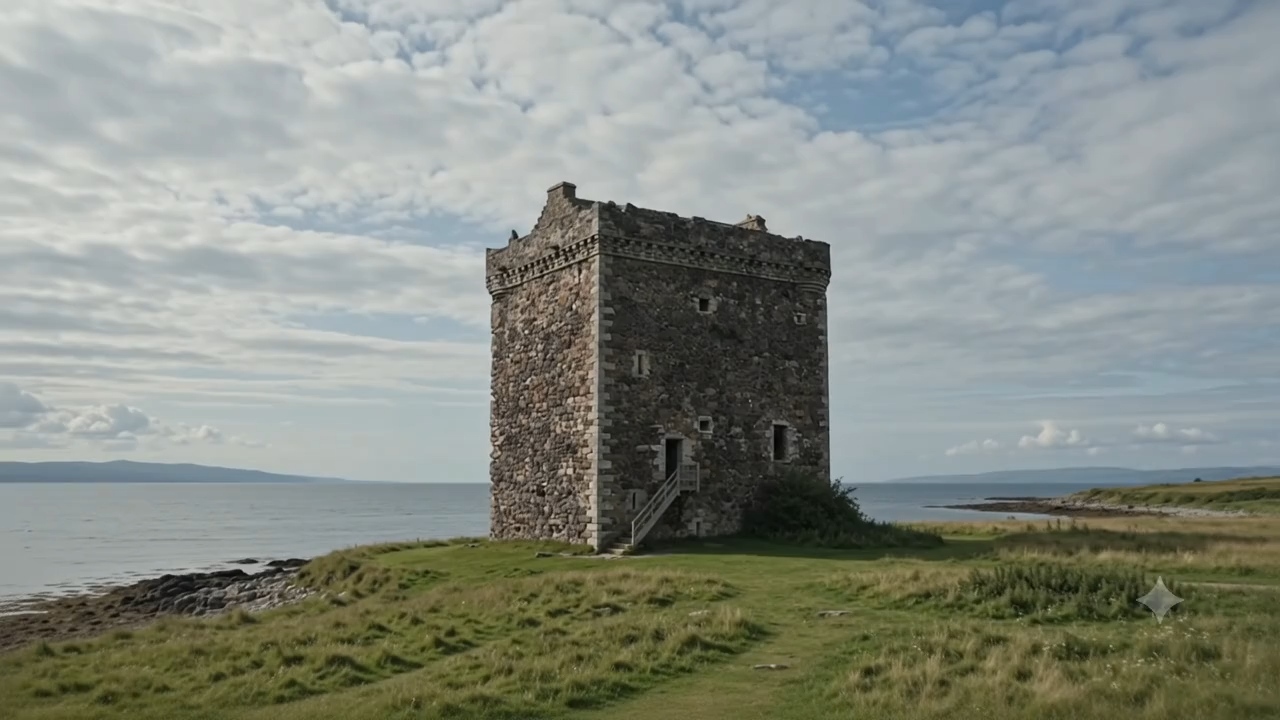
Little Cumbrae Castle
Little Cumbrae Castle is a Scottish tower house located on Castle Island built in the 16th Century. It was built by the Montgomery family, Earl of Eglinton, it served as a defensive residence to control the resources of the island and protect the island against poaching. The site has earlier royal associations as Robert II visited the island in the late 14th century, but the present castle dates to the mid-1500s. Architecturally, this castle is a compact rectangular tower with thick stone walls and vaulted cellars on the ground floor. The entrance to this castle is from the first floor, highlighting its defensive purpose. It is elevated on a rocky outcrop making it vulnerable to high sea winds, thus affecting its tiny windows. The materials used for this castle are local stone, giving the interior a cool, heavy, and enclosed character typical of Scottish tower houses. Now the tower is roofless and unoccupied, and it remains an important scheduled monument that reflects both its strategic coastal setting and its role as a fortified domestic residence. In this project, I wanted to extend the castle, based on its vanished roof. I chose that because the castle was built for security, yet its small windows do not provide a clear view of the surroundings. I planned to add a small green area on the roof, because the castle had no access to greenery inside. I also adjusted the size of the kitchen because it's very small. I used stone columns and timber for the roof itself.
Research

Little Cumbrae Castle is a Scottish tower house located on Castle Island built in the 16th Century. It was built by the Montgomery family, Earl of Eglinton, it served as a defensive residence to control the resources of the island and protect the island against poaching. The site has earlier royal associations as Robert II visited the island in the late 14th century, but the present castle dates to the mid-1500s. Architecturally, this castle is a compact rectangular tower with thick stone walls and vaulted cellars on the ground floor. The entrance to this castle is from the first floor, highlighting its defensive purpose. It is elevated on a rocky outcrop making it vulnerable to high sea winds, thus affecting its tiny windows. The materials used for this castle are local stone, giving the interior a cool, heavy, and enclosed character typical of Scottish tower houses. Now the tower is roofless and unoccupied, and it remains an important scheduled monument that reflects both its strategic coastal setting and its role as a fortified domestic residence.
In this project, I wanted to extend the castle, based on its vanished roof. I chose that because the castle was built for security, yet its small windows do not provide a clear view of the surroundings. I planned to add a small green area on the roof, because the castle had no access to greenery inside. I also adjusted the size of the kitchen because it's very small. I used stone columns and timber for the roof itself.
Site Plan

To gain a comprehensive understanding of both the landscape and the historic structure, I developed a detailed site plan, alongside precise elevation and cross-section drawings, which allowed me to analyze the spatial relationship between the castle and its immediate context.
Plan Drawings


Axonometric Drawing

To deepen my spatial analysis, I produced a cutaway axonometric drawing that simultaneously illustrates the castle's internal programming and external envelope. This comprehensive three-dimensional perspective was instrumental in the decision-making process, directly informing my strategy on which historic fabric to preserve and which elements to actively restore.
Design Development

At this stage of the project, I initiated a series of iterative design sketches exploring potential restoration strategies for the castle's roof. To transition these initial concepts from two-dimensional ideas into tangible forms, I constructed a physical volumetric study model, which allowed me to evaluate how the proposed roof profiles would perform in reality and harmonize with the existing historic massing.


Proposed Key Section

Proposed Axonometric

For the final design intervention, I utilized the castle's existing perimeter walls to support a new, strategically engineered roof structure. The roof slopes inward to form a central catchment system that channels rainwater into the heart of the tower house, nurturing a localized interior garden. To honor the castle's historical legacy as a defensive island guardpost, I integrated a series of observation points with telescopes around the roof deck. Because the original structure features narrow arrow-slits and deeply recessed windows with severely restricted lines of sight, this elevated, sheltered platform allows visitors to experience panoramic, 360-degree views of the island while remaining entirely protected from the elements.
Final Design Render

Vanbrugh Park Estate
· 2025
Continue →